Toshiba EM131A5C-BS Review: Countertop Microwave Overview
Toshiba’s EM131A5C-BS countertop microwave pairs a 1.2-cubic-foot cavity with Smart Humidity Sensor technology, its most distinctive feature, which reads steam levels rising from food and adjusts cooking time automatically rather than depending on a single fixed timer. This Toshiba EM131A5C-BS review looks at how that sensor-driven approach, combined with 1000 watts of microwave output and a 12.4-inch turntable, holds up against the everyday demands of reheating, defrosting, and quick meal prep in smaller households, apartments, and shared office kitchens. Countertop microwaves in the 1.0 to 1.5 cubic foot range are typically chosen because they balance internal capacity against a compact external footprint, and the EM131A5C-BS sits squarely in that category with a Black Stainless Steel finish designed to resist fingerprints and blend with modern kitchen hardware. Beyond raw wattage, buyers evaluating a mid-size microwave generally weigh control layout, preset variety, noise during operation, and how easily the interior wipes clean after splattered sauces or boiled-over liquids. The sections that follow break down the EM131A5C-BS across these factors, drawing on its published specifications, control architecture, and the patterns that emerge from a large base of aggregated customer feedback, to help determine which kitchens and cooking habits this model suits and where a different capacity or feature set might be a better match.
Quick Overview
| Feature | Details |
|---|---|
| Appliance Type | Countertop microwave oven |
| Capacity | 1.2 cubic feet |
| Power Output | 1000 watts (1600W input, 1550W energy consumption) |
| Power Levels | 10 selectable levels |
| Turntable | 12.4-inch removable glass turntable with roller ring |
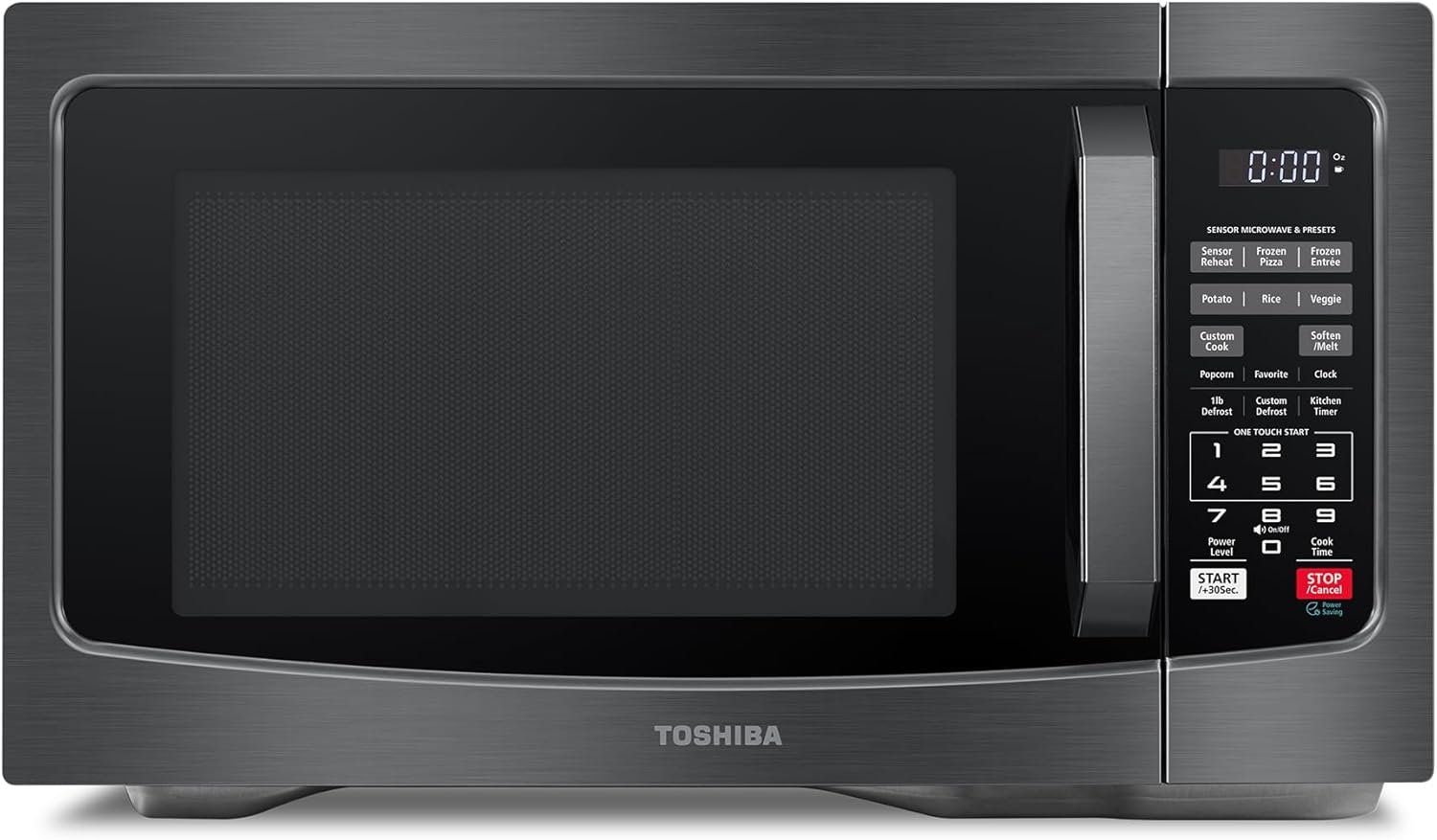
| Control Type | Touch keypad with digital display, clock, and countdown timer |
| Preset Menus | 6 preset menus plus sensor reheat and defrost-by-weight/time |
| Special Modes | Smart Humidity Sensor, ECO mode, Mute function |
| Exterior Material | Black Stainless Steel |
| Interior Material | Stainless steel cavity |
| External Dimensions | 20.6″W x 14.6″D x 11.8″H |
| Internal Dimensions | 13.1″W x 12.4″D x 8.3″H |
| Item Weight | 34.6 pounds |
| Recommended Use | Residential countertop installation |
| Warranty | 1-year limited warranty |
The specifications above translate into a microwave sized for daily single- or dual-person cooking tasks rather than large-batch meal prep. Its 1000-watt output and ten power levels give it enough strength for typical reheating and beverage heating, while the sensor and preset menus reduce the guesswork of matching time and power to different food types, and the compact external footprint keeps it manageable on a standard countertop or break room shelf.

Capacity, Footprint, and Kitchen Fit
At 1.2 cubic feet, the EM131A5C-BS occupies the middle tier of countertop microwave capacity, larger than compact 0.7 to 0.9 cubic foot models often marketed for dorm rooms but smaller than full-size 1.6 to 2.2 cubic foot family units. That interior volume, paired with a 12.4-inch turntable, comfortably accommodates a dinner plate, a standard mug, or a medium mixing bowl without requiring items to be repositioned mid-cycle. Externally, the unit measures 20.6 by 14.6 by 11.8 inches and weighs 34.6 pounds, dimensions that fit most standard countertop depths without overhanging the edge, though the footprint still requires roughly two square feet of clear counter or shelf space plus ventilation clearance around the vents. Buyers working with narrow kitchen counters, small apartment layouts, or shared break room carts generally find this size category strikes a workable balance between usable interior space and the external bulk a countertop appliance adds to a room.

Interior Cavity and Turntable
The internal cavity measures 13.1 by 12.4 by 8.3 inches, dimensions that leave enough vertical clearance for a standard travel mug or a covered casserole dish, though taller stockpots or oversized mixing bowls may not clear the ceiling of the compartment. The 12.4-inch glass turntable rotates on a removable roller ring, a design that supports even sensor-based heat distribution because food rotates continuously through the microwave’s field rather than sitting in one fixed position.
Because the turntable and roller ring lift out separately, both components can be washed independently in a sink, which matters for households that regularly reheat sauces or cheese-topped dishes prone to boiling over and leaving residue in hard-to-reach corners of a fixed cavity floor.
Exterior Footprint and Placement
Positioned on a countertop, the EM131A5C-BS’s 20.6-inch width and 14.6-inch depth mean it will fit within most 24-inch-deep counter runs while leaving room behind the unit for the required ventilation gap manufacturers typically specify for microwave exhaust. Its 11.8-inch height also keeps it low enough to slide beneath most upper cabinets in standard 18-inch-clearance kitchen layouts, an important consideration in galley kitchens or apartment units with limited vertical counter space.
At 34.6 pounds, the unit is light enough for one person to reposition during cleaning or a countertop reorganization, but heavy enough that permanent placement near the edge of a shelf or cart is not advisable given the moderate risk of tipping.
Power, Sensor Cooking, and Performance
Microwave performance is generally a function of wattage, power-level granularity, and how consistently a unit distributes energy through food, and the EM131A5C-BS addresses each with a 1000-watt output split across ten selectable power levels. That wattage places it above entry-level 700 to 900-watt microwaves, which typically require longer cook times to reach comparable internal temperatures, while stopping short of the 1200-plus-watt output found in larger family-size units built for faster batch cooking. The inclusion of Smart Humidity Sensor technology is the more significant performance differentiator: rather than running a fixed timer regardless of food condition, the sensor tracks steam output during the early seconds of a cook cycle and recalculates the remaining time and power needed, a method that generally reduces the overcooking and cold-center outcomes common with manually timed reheating.

Wattage and Power Level Control
Ten discrete power levels give the EM131A5C-BS more granular control than the five- or six-level scales found on many budget microwaves, allowing output to be dialed down for tasks like softening butter or melting chocolate where full 1000-watt power would scorch or unevenly heat delicate ingredients. Full power remains available for water boiling, quick reheating, and standard cook-from-frozen tasks where speed matters more than gentle heat distribution.
The 1600-watt input rating and 1550-watt energy consumption figure indicate the unit draws a meaningful but standard household-circuit load, consistent with most countertop microwaves in its wattage class and unlikely to require dedicated wiring in a typical kitchen outlet.
Smart Humidity Sensor Cooking
The humidity sensor’s practical value is concentrated in reheating tasks, where food moisture content varies significantly between a dry dinner roll and a broth-based soup; a fixed timer treats both identically, while sensor-based cooking adjusts to each. Toshiba’s implementation covers six popular food categories through its sensor reheat function, reducing the need to estimate time manually for common leftovers.
This approach does have a practical limit: sensor accuracy depends on the food being loosely covered or vented so steam can escape and register on the sensor, meaning tightly sealed containers can reduce the feature’s effectiveness.
Defrost and One-Touch Start
Defrosting can be set by weight or by time, giving flexibility depending on whether a package’s weight is known or the item was already prepped and simply needs a fixed thaw window. One-touch start lets a user begin cooking at full power for one to six minutes simply by pressing the corresponding number key, a shortcut aimed at frequent, predictable tasks like reheating a cup of coffee or a bowl of leftovers.
If more time is needed mid-cycle, pressing the start button again adds 30 additional seconds without restarting the program, a small convenience that reduces the need to reprogram a cycle from scratch.
Controls, Presets, and Ease of Operation
Ease of operation on a countertop microwave is shaped primarily by how intuitively its control panel maps physical tasks to button presses, and the EM131A5C-BS relies on a touch keypad paired with a digital display that shows the clock, a countdown timer, and remaining cook time simultaneously. Twelve auto menu functions, covering six preset food categories plus sensor reheat, defrost, and memory settings, are intended to reduce the need to manually calculate time and power combinations for routine meals. A large, contoured door handle is built for one-handed opening even when the other hand is holding a plate, a detail that matters more in shared kitchens where the microwave sees frequent, quick-turnaround use throughout the day rather than occasional, deliberate cooking sessions.

Digital Display and Touch Interface
The touch-based keypad avoids the mechanical dial or physical button wear common on older microwave designs, and the digital display’s ability to toggle between clock, countdown timer, and remaining cook time keeps the current cycle status visible without requiring the door to be opened to check progress. Button-based touch interfaces also tend to be easier to wipe clean than raised physical buttons, since there are fewer seams for food splatter to collect in.
Some touch interfaces can feel less tactile than a dial or push-button design, particularly for users who prefer physical feedback confirming a button press was registered.
Twelve Auto Menus and Custom Presets
The six built-in preset menus, covering foods like pizza and vegetables alongside a dedicated sensor reheat option, are designed to remove trial-and-error guesswork for commonly cooked items. Layered on top of the auto menus, the ability to program up to three custom time-and-power combinations lets frequent users save settings for dishes not covered by the built-in presets, such as a specific reheating routine for a favorite meal.
This preset structure suits households with repetitive cooking patterns more than those who cook a wide variety of unpredictable dishes requiring manual power and time adjustments each time.
Mute Function and ECO Standby Mode
The mute function allows the end-of-cycle and button-press tones to be silenced, a feature particularly relevant in office break rooms, shared apartments, or households with infants where beeping at unpredictable hours is disruptive. ECO mode reduces standby power draw when the unit is idle, addressing the small but continuous electricity use that digital-display appliances draw around the clock.
Neither feature affects cooking performance directly, but both address secondary ownership concerns, noise tolerance and background energy use, that factor into daily satisfaction with a shared or frequently used appliance.
Noise, Cleaning, and Long-Term Durability
Countertop microwaves generate operational noise primarily from the cooling fan and the turntable motor, and units in the 1000-watt class like the EM131A5C-BS typically produce a moderate hum during operation rather than the louder output associated with higher-wattage convection or combination microwaves. Interior durability depends heavily on cavity material and how resistant the surface is to staining and scratching from repeated splatters, and the stainless-steel interior here is a more scratch- and stain-resistant choice than the painted-metal cavities found in many budget models, though it still benefits from prompt wiping after boil-overs to prevent baked-on residue. The Black Stainless Steel exterior is similarly chosen for its resistance to visible fingerprints and smudging compared to standard stainless or glossy plastic finishes, a practical consideration for a surface handled multiple times daily.

Operating Noise and Vibration
Fan and turntable noise on a 1000-watt microwave is generally comparable across the category, since motor size and cooling requirements scale closely with wattage rather than brand. Vibration is typically minimal given the unit’s 34.6-pound weight, which is heavy enough to stay stable on a countertop during a spinning turntable cycle without noticeable rocking or movement.
Noise levels are more likely to be affected by placement, units set on a hollow cabinet-top or unstable shelf may transmit more audible vibration than the same unit on a solid countertop.
Interior Material and Cleaning
A stainless-steel interior resists the yellowing and pitting that can develop in painted-metal cavities over years of use, and its smoother surface generally wipes clean more easily after typical food splatters than textured or coated alternatives. The removable turntable and roller ring further simplify cleaning by allowing both components to be washed separately from the fixed cavity walls.
Long-term reliability for microwaves in this category is generally tied to how consistently the interior is cleaned, since accumulated residue can affect sensor accuracy over time by altering how steam and heat are read during a cook cycle.
Ideal Kitchens, Users, and Workloads
Matching a microwave’s capacity and feature set to actual household workload is one of the more overlooked factors in appliance selection, since an undersized unit frustrates larger families while an oversized one wastes counter space in a small kitchen. The EM131A5C-BS’s 1.2-cubic-foot capacity and 1000-watt output are proportioned for one to three regular users handling reheating, defrosting, and light cooking tasks rather than full meal preparation for a larger household. Its preset-driven, sensor-assisted design also favors users who value convenience and consistency over granular manual control, since the auto menus and humidity sensor are built to minimize decision-making rather than maximize customization. Considered against the wider countertop microwave category in 2026, its combination of capacity, sensor cooking, and mute and ECO functions positions it as a mid-tier option suited to everyday convenience use.

Households and Spaces That Fit Best
Apartments, dorm-adjacent living situations, small households of one to three people, and shared office break rooms are the settings where a 1.2-cubic-foot, sensor-equipped microwave like this one tends to perform best, since its capacity comfortably handles individual plates and standard packaged servings without excess unused interior space. The auto menu presets also suit users who reheat similar meals regularly and benefit from not having to reprogram time and power settings each use.
Secondary kitchens, such as a basement or garage prep area supplementing a main kitchen, are another practical fit given the unit’s manageable footprint and weight.
Who Should Consider a Different Model
Larger households that regularly reheat multiple full-size dishes simultaneously, or that cook large casserole trays and stockpot-sized containers, may find the 13.1 by 12.4 by 8.3-inch interior cavity restrictive compared to full-size 1.6-plus cubic foot models built for that volume. Households seeking convection, air-fry, or grill functionality in a single appliance will also need to look beyond this model, since it is built specifically around standard microwave heating rather than multi-function cooking.
Users who prefer extensive manual control over every time and power variable, rather than relying on preset menus and sensor automation, may find the auto-menu-forward design less flexible than a purely manual unit.

Pros & Cons
Pros
- Smart Humidity Sensor technology adjusts cooking and reheating time automatically based on steam output, reducing the manual guesswork involved in matching time to food type and moisture content.
- Ten selectable power levels provide finer control than the five- or six-level scales common on budget microwaves, useful for delicate tasks like softening or melting ingredients.
- Removable 12.4-inch turntable and roller ring simplify cleaning by allowing both components to be washed separately from the main cavity.
- Stainless-steel interior resists staining and pitting better than painted-metal cavities, supporting easier long-term maintenance.
- Mute function and ECO mode address secondary but common ownership concerns, disruptive beeping and idle energy draw, without affecting core cooking performance.
- Twelve auto menu options plus three programmable presets reduce repetitive manual entry for frequently reheated meals.
- Compact 1.2-cubic-foot capacity in a 20.6-inch-wide footprint fits smaller countertops, apartments, and break room settings without excessive bulk.
- Large, contoured door handle supports one-handed opening, a convenience in shared or high-traffic kitchen settings.
Cons
- 13.1 by 12.4 by 8.3-inch interior cavity may not accommodate tall stockpots, oversized casserole dishes, or large family-size servings.
- Sensor reheat accuracy depends on venting, meaning tightly sealed containers can reduce the feature’s effectiveness compared to loosely covered dishes.
- Touch-based controls may feel less tactile than physical dial or button interfaces for users who prefer manual feedback.
- 1000-watt output, while adequate for reheating and defrosting, cooks more slowly than higher-wattage 1200-plus-watt models when speed is the priority.
- No convection, air-fry, or grill functionality, limiting the unit to standard microwave heating rather than multi-function cooking.
Final Verdict: Who This Appliance Is Best For (and Who Should Skip It)
The Toshiba EM131A5C-BS is best suited to individuals, couples, small families, and shared spaces like office break rooms that need dependable reheating, defrosting, and light cooking rather than full-scale meal preparation. Its 1.2-cubic-foot capacity, 1000-watt sensor-assisted cooking, and preset-heavy control layout are proportioned for convenience-focused daily use, and the mute function, ECO mode, and stainless-steel interior address the secondary maintenance and noise concerns that matter most in frequently used, shared appliances.
Buyers who regularly cook for larger households, need convection or air-fry versatility, or prefer manual control over every power and time variable will likely find better alignment with a larger, multi-function, or purely manual model instead. Compared against the broader field of countertop microwaves available in 2026, the EM131A5C-BS occupies a practical mid-capacity, sensor-equipped niche: it prioritizes consistent, low-effort reheating over raw power or expanded cooking modes, making it a fit for predictable, moderate-volume kitchen workloads rather than heavy or highly varied cooking demands.
Frequently Asked Questions (FAQs)
How many watts is the Toshiba EM131A5C-BS microwave?
The Toshiba EM131A5C-BS outputs 1000 watts of microwave power, drawing 1600 watts of input power and consuming approximately 1550 watts during operation. This wattage places it in the mid-range category for countertop microwaves, strong enough for standard reheating, defrosting, and boiling tasks while using less energy and generating less heat than higher-wattage 1200-plus-watt models designed for faster batch cooking or larger households. Ten adjustable power levels allow that output to be scaled down for gentler tasks.
What size is the Toshiba EM131A5C-BS microwave?
The unit measures 20.6 inches wide, 14.6 inches deep, and 11.8 inches tall on the outside, with an internal cavity of 13.1 by 12.4 by 8.3 inches and a total capacity of 1.2 cubic feet. It weighs 34.6 pounds, a size category generally considered mid-sized, larger than compact dorm-style microwaves but smaller than full-size family units. This footprint typically fits standard countertops, apartment kitchens, and shared break room spaces without requiring extensive clearance.
Does the Toshiba EM131A5C-BS have a sensor cooking feature?
Yes, it includes Smart Humidity Sensor technology that detects steam released from food during the early stage of a cook cycle and automatically adjusts the remaining cooking time and power level. This sensor-based approach is applied to reheating popular food categories, reducing the need to manually estimate time and power based on food type or portion size. Accuracy depends on food being loosely covered so steam can be read properly by the sensor.
How many preset menu options does this microwave offer?
The EM131A5C-BS includes six preset auto menus for popular foods along with sensor reheat, defrost-by-weight, defrost-by-time, and the ability to save up to three custom time-and-power combinations. Combined, these functions are often described as twelve auto menu options, designed to reduce manual programming for routinely prepared meals and reheated leftovers. One-touch start also provides a quick shortcut for common one- to six-minute full-power cook times.
Can the Toshiba EM131A5C-BS be muted?
Yes, the microwave includes a dedicated mute function that silences the end-of-cycle alert tones and button-press sounds. This is particularly useful in shared spaces such as office break rooms, apartments, or households with sleeping infants, where audible beeping at unpredictable times can be disruptive to others nearby. The setting can typically be toggled independently of other cooking functions and does not affect sensor or power performance.
What material is the interior of the EM131A5C-BS made from?
The interior cavity is constructed from stainless steel, a material generally more resistant to staining, pitting, and long-term wear than the painted-metal interiors found in many budget microwave models. A removable glass turntable and roller ring further simplify cleaning, since both components can be washed separately from the cavity walls. The Black Stainless Steel exterior is also designed to resist visible fingerprints and smudging.
Does the Toshiba EM131A5C-BS have a convection or air-fry function?
No, this model is a standard microwave oven without convection, air-fry, or grill functionality. It is built specifically around microwave heating enhanced by humidity-sensor automation, power-level control, and preset menus, rather than the multi-function cooking modes found in combination convection-microwave appliances. Buyers wanting browning, crisping, or oven-style baking will need a separate or combination appliance, since this unit focuses on reheating, defrosting, and standard cooking tasks instead.
What does ECO mode do on this microwave?
ECO mode reduces the microwave’s standby power consumption when the unit is idle and not actively cooking. Because digital displays and touch controls draw a small continuous electrical load around the clock, ECO mode is intended to minimize that background energy use without affecting the appliance’s cooking performance or available power levels. It can typically be enabled or disabled independent of other settings.